














The Fast Facts
- Tinted sunscreens are as effective as ‘traditional’ sunscreens in protecting your skin from UV rays.
- Most tinted sunscreens are mineral based and contain iron oxide, which gives them that ‘tint’.
- EltaMD’s UV line, Tower 28, and La Roche-Posay are some of our picks of the best tinted sunscreens.
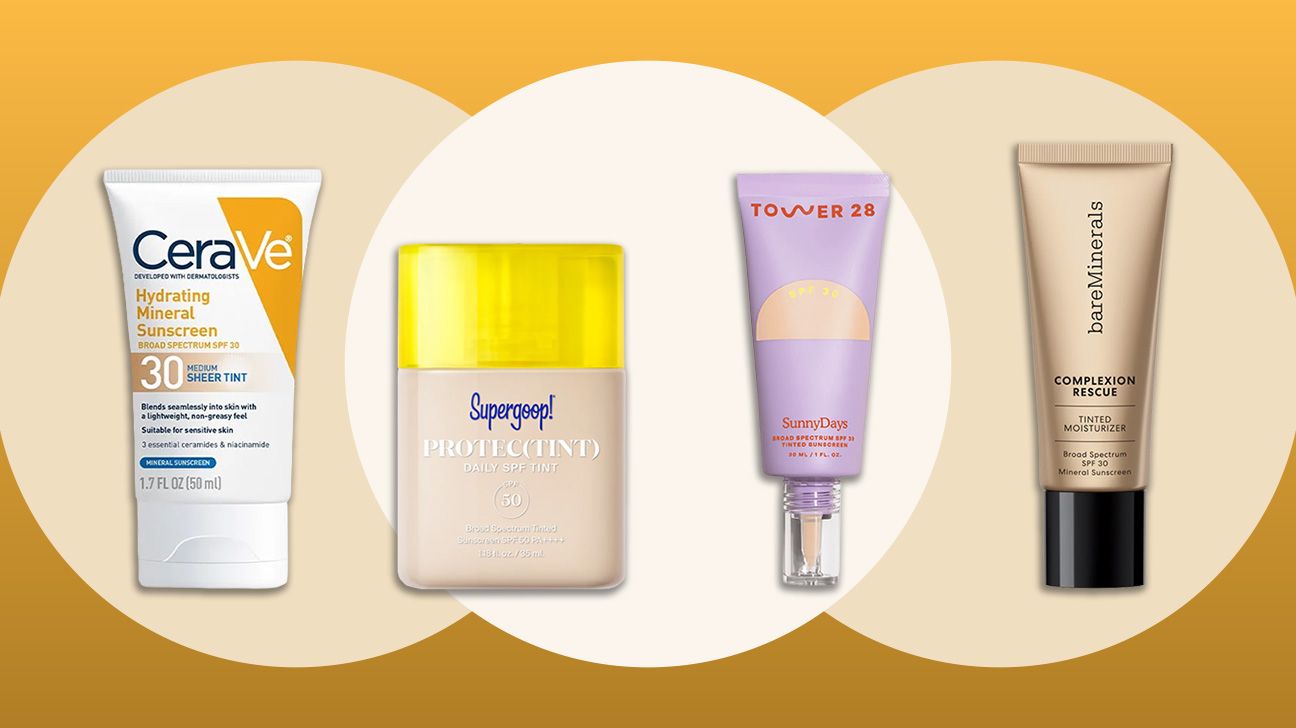
- Best tinted sunscreen for dry skin: Bare Minerals Complexion Rescue Tinted Sunscreen | Skip to review
Whether you’re staying in or going out, daily sun protection is essential. And a seamless way to work more SPF into your morning skin care routine is through tinted sunscreen.
Most tinted sunscreens include active ingredients like zinc oxide and titanium dioxide, as well as iron oxide, which gives a tinted pigment to the sunscreen. These pigments reflect visible light in ways that other sunscreens can’t.
While there are foundations and moisturizers out there with SPF, usually they’re not as reliable or effective as dedicated sunscreens with a tint.
We sat with Paul Regan, MD, FAAD, to help guide us on what makes a tinted sunscreen the ‘best’. He shared his input, and we used his guidelines to choose these 8 as our top picks.
Medical PerspectiveDoes the minimum SPF in tinted sunscreen change by skin shade?
The minimum SPF recommended does not change by skin tone in order to achieve the same level of protection.
The minimum SPF should be 30 to ensure effective UV protection, though higher SPF ratings are encouraged given that people often apply less than the recommended amount to achieve that SPF rating.
Learn more about sun protection.
Quotes represent the opinions of our medical experts. All content is strictly informational and should not be considered medical advice.
| Brand | Price | Size | Protection | Number of shades |
|---|---|---|---|---|
| EltaMD | $47 | 1.7 oz | SPF 46 | 5 shade ranges |
| CeraVe | $15.99 | 1.7 oz | SPF 30 | 3 shade ranges |
| La Roche-Posay | $39.99 | 1.7 oz | SPF 40 | 4 shade ranges |
| Bare Minerals | $39.50 | 1.18 oz | SPF 30 | 20 shades |
| Ilia | $48 | 1 oz | SPF 40 | 30 shades |
| Laura Mercier | $50 | 1.5 oz | SPF 30 | 20 shades |
| Tower 28 | $32 | 1 oz | SPF 30 | 17 shades |
| Supergoop! | $44 | 1.18 oz | SPF 50 | 14 shades |
Every product that’s included in our roundups first have to pass our rigorous vetting process. From there, we narrowed down the list from 20+ sunscreens to these 8 with the following factors:
- Experts: We had an expert run through our choices and guide us on which brands would make sense to keep in our roundup, based on their expertise and these factors.
- Quality indicators: Sunscreens that were clinically tested by dermatologists and ophthalmologists were prioritized for this roundup. Any products that had certifications were an added bonus.
- Ingredients: Tinted sunscreens are usually mineral-based and skincare-focused, so we ensured the ingredients were listed transparently. We also made sure each product had at least SPF 30.
- Shade ranges: Since tinted sunscreens can be blended and built upon, we focused on brands that had at least 3 different skin shades and were sheer enough to be a base layer for makeup.
- Price: There are more than 20 sunscreens out there. We tried to stick to options of $50 or under, recognizing that tinted sunscreens can be more expensive, but they can still be at a good price point.
Tinted sunscreens are versatile. They can be worn alone or act as a base layer under makeup. The best part is that it protects your skin from visible light, which is the light you see from the sun. Traditional sunscreen protects you from ultraviolet A and B (UVA and UVB) rays.
Which SPF is best?
These rays are the invisible, stronger kind that cause sunburn, visible signs of aging, sun damage, hyperpigmentation, and increase the risk of skin cancer. Try to use a sunscreen that’s SPF 30 or higher to help prevent these risks, and broad-spectrum sunscreens that protect against both UVA and UVB rays.
“Recent studies have shown that light in the visible wavelength spectrum has an impact on skin pigmentation,” Dr. Regan said, “particularly hyperpigmentation in darker skin tones and erythema in lighter skin tones.
“People with melasma, post-inflammatory hyperpigmentation from acne, or other disorders of hyperpigmentation may want to consider using a tinted sunscreen if their goal is to lighten these areas, given the visible light protection tinted sunscreens offer.”
Medical PerspectiveWhat is the recommended amount of sunscreen to apply to your face?
In general, people should apply about a nickel-sized amount of sunscreen to the face. Another way to remember this is: The amount of sunscreen needed should cover the length of your index and middle fingers.
(Also known as the “two-finger” rule.)
Want more info on sunscreen? Take a look at our ultimate sunscreen guide.
Quotes represent the opinions of our medical experts. All content is strictly informational and should not be considered medical advice.
What ingredients should tinted sunscreens have?
The ingredients in tinted sunscreens are the same as those in traditional sunscreens, both chemical and mineral.
“Chemical sunscreens use organic compounds like avobenzone, octocrylene, and homosalate,” Dr. Regan said. “These compounds absorb UV light.” Mineral sunscreens, on the other hand, contain zinc oxide or titanium dioxide as the UV filter. These ingredients will sit on the surface of your skin to protect it from the UV rays.
Tinted sunscreens have the added power of iron oxide, the ingredient that gives them their tint, as well as enhanced protection against visible light.
Tinted sunscreens are just as good as “traditional” sunscreens at protecting you from UV rays. The added iron oxide in tinted sunscreens gives you an extra boost in protecting you from visible light in addition to UVA and UVB rays. Plus, it makes it easier to add to your daily routine.
The same guidelines apply to both: wear SPF 30 or higher daily, use the “two-finger” rule to apply the needed amount of sunscreen, and reapply every two hours.
Tinted sunscreens contain iron oxide, which blocks both UV and blue light. Additionally, tinted sunscreens contain pigments that blend in seamlessly to the skin and can be used in lieu of foundation. No more white cast!
Some common misconceptions include:
- Truth: Tinted sunscreen usually offers a higher level of UV protection than makeup with SPF.
- Truth: As long as the SPF rating is the same and the products are applied adequately, tinted sunscreen and traditional sunscreen offer the same level of UV protection.
- Truth: If you are going to be exposed to UV light for prolonged periods, it is recommended to reapply sunscreen every 2 to 3 hours.
The best sunscreens for melasma are mineral-based and contain iron oxides (which give sunscreens a ‘tint’). These ingredients protect the skin’s surface from visible light, in addition to UVA and UVB rays.
Most of the options in this roundup are mineral-based sunscreens that contain iron oxide.