














Key takeaways
- Spiriva (tiotropium bromide) is a brand-name, prescription inhaler that’s used to help manage symptoms of COPD and asthma in adults and some children. It’s also available in a generic version.
- Spiriva comes in two forms: Spiriva Handihaler and Spiriva Respimat. The form you’re prescribed will depend on several factors, including your age and the specific condition you’re using Spiriva to treat.
- Spiriva is used as a once-daily maintenance inhaler to help prevent COPD flare-ups and asthma attacks. Neither form of Spiriva is approved for use as a rescue inhaler to stop an active episode.
Spiriva contains the active ingredient tiotropium. (An active ingredient is what makes a drug work.) Spiriva belongs to a group of drugs called anticholinergics.
Spiriva Respimat comes with a cartridge containing a liquid form of Spiriva and an inhaler device called the Respimat. The Respimat delivers the Spiriva liquid as a fine mist that you breathe in.
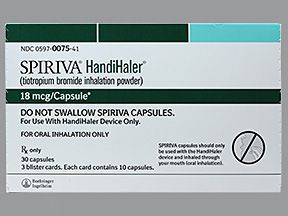
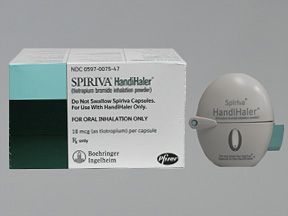
Spiriva HandiHaler comes with capsules containing Spiriva powder and an inhaler device called the HandiHaler. The HandiHaler pierces the capsule, allowing you to breathe in the Spiriva powder.
Spiriva is used to treat asthma and chronic obstructive pulmonary disease (COPD). The medication comes in two forms: Spiriva Respimat and Spiriva HandiHaler. The form your doctor prescribes depends on the condition you’re using it to treat.
Spiriva for COPD
Spiriva Respimat and Spiriva HandiHaler are both used to treat COPD in adults.
COPD is a chronic (long term) lung condition that gradually worsens over time. With COPD, you typically have a mixture of emphysema and chronic bronchitis.
For this condition, you’ll take Spiriva every day to relax your airways and keep them open. This can make breathing easier and help relieve your symptoms.
Spiriva for asthma
Spiriva Respimat is prescribed to treat asthma in adults and in children ages 6 years and older. Spiriva Handihaler is not used to treat asthma. (The HandiHaler is used to treat COPD only.)
With asthma, you have inflammation (swelling) and narrowing of your airways. This can cause wheezing, cough, chest tightness, and shortness of breath. Certain triggers may make your symptoms suddenly get worse. This is called an asthma attack.
For asthma, you’ll take Spiriva every day to relax your airways and help keep them open. This can make breathing easier and help relieve your symptoms. And it can help prevent asthma attacks.
It’s important to note that Spiriva is not a rescue inhaler. It won’t work to relieve an asthma attack or a COPD flare-up. While using Spiriva, continue using your rescue inhaler as directed by your doctor if you have sudden breathing problems or worsened symptoms.
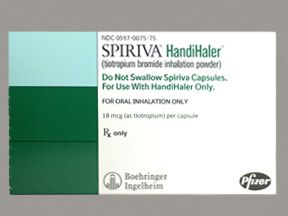
Spiriva images
Like most drugs, Spiriva may cause mild or serious side effects. The lists below describe some of the more common side effects that Spiriva may cause. These lists don’t include all possible side effects.
To learn about other side effects, talk with your doctor or pharmacist, or read the prescribing information for Spiriva Respimat or Spiriva HandiHaler.
Mild side effects that people using Spiriva have reported include:
- sore throat
- dry mouth
- headache
- upper respiratory infection, such as the common cold
- blurry vision
- indigestion (upset stomach)
Mild side effects of many drugs may go away on their own within a few days to a couple of weeks. But if they become bothersome, talk with your doctor or pharmacist about ways to manage them.
Serious side effects
Serious side effects from Spiriva can occur, but they aren’t common. If you have serious side effects from Spiriva, call your doctor right away. But if you think you’re having a medical emergency, you should call 911 or your local emergency number.
Serious side effects that people using Spiriva have reported include:
- new or worsened urinary retention (not being able to completely empty your bladder)
- paradoxical bronchospasm (sudden tightening of your airways after taking a dose of Spiriva)
- serious allergic reaction, including anaphylaxis and angioedema
Your doctor will recommend the dosage of Spiriva that’s right for you. Below are commonly used dosages, but always take the dosage your doctor prescribes.
Forms and strengths
Spiriva is available in the following forms and strengths:
- Spiriva Respimat: This comes with an inhaler device called the Respimat and a cartridge containing a liquid form of Spiriva. The Respimat delivers the Spiriva liquid as a fine mist that you breathe in. Two strengths are available: 1.25 micrograms (mcg) per puff and 2.5 mcg per puff.
- Spiriva HandiHaler: This comes with an inhaler device called the HandiHaler and capsules containing Spiriva powder. The HandiHaler pierces the capsule so that you can breathe in the Spiriva powder. Each capsule contains 18 mcg of Spiriva.
Recommended dosages for asthma and COPD
The specific form and strength you’re prescribed will depend on the condition you’re using Spiriva to treat.
However, the recommended dosage of Spiriva for asthma and COPD is the same regardless: 2 puffs per day.
Questions about Spiriva’s dosing
Below are some common questions about Spiriva’s dosing.
- What if I miss a dose of Spiriva? If you miss a dose of Spiriva, take it as soon as possible. But if it’s almost time for your next dose, skip the missed dose and take your next dose as scheduled. You should not take two doses at once to make up for a missed dose. This can raise your risk of side effects.
- Will I need to use Spiriva long term? Yes, Spiriva is meant to be used as a long-term treatment. If you and your doctor determine that Spiriva is safe and effective for you, you’ll likely use it long term.
- How long does Spiriva take to work? Spiriva starts working to open your airways about 1 hour after you first take a dose. But it may take a few weeks before your symptoms are noticeably improved. If you have questions about what to expect from Spiriva treatment, talk with your doctor.
What to do in case you use too much Spiriva
Call your doctor if you think you’ve used too much Spiriva. You can also call 800-222-1222 to reach Poison Help or use its online resource. But if you have severe symptoms, immediately call 911 or your local emergency number. Or go to the nearest emergency room.
Find answers to some commonly asked questions about Spiriva.
No, Spiriva capsules should never be swallowed. Spiriva capsules (used with the HandiHaler device) are strictly for oral inhalation only. If you swallow these capsules, the medication will be processed through your digestive tract rather than your lungs, making it ineffective for COPD.
Always store capsules in their sealed blister packaging and only insert them into the center chamber of your HandiHaler device immediately before inhaling. If you or someone else accidentally swallows a Spiriva capsule, consult your doctor or contact a poison control center (such as Poison Help) right away.
To prevent drug buildup, blockages, and contamination from saliva, it’s important to clean your Spiriva device regularly. However, Spiriva inhalers should be cleaned and dried without cleaning agents, detergents, or hair dryers.
Spiriva Respimat: Clean the mouthpiece, including the metal element inside the mouthpiece, at least once per week using only a clean, damp cloth or tissue. Unlike the HandiHaler, it’s not safe to rinse or submerge the Respimat device or cartridge in water.
Spiriva HandiHaler: Clean as needed by rinsing the entire open device under running warm water. While rinsing, it’s important to press the green piercing button several times to clear the needle and center chamber of residual gelatin or powder.
Afterward, tap out excess water on a paper towel and air-dry the device with the dust cap, mouthpiece, and base completely open. Do not use the HandiHaler while it is wet.
A Spiriva Respimat inhaler should be discarded exactly 3 months after its first use, or when the dose indicator reaches the end of the red scale, whichever comes first.
When the inhaler is empty (typically after 60 full doses), the device will automatically lock.
Before taking Spiriva, you should talk with your doctor about your overall health, any medical conditions you may have, and other medications you take. All these factors can affect whether Spiriva is a good option for you.
Drug interactions
Spiriva is a kind of drug called an anticholinergic. It can interact with several types of drugs, including other anticholinergics. Examples of these drugs include:
- ipratropium (Atrovent HFA)
- oxybutynin (Ditropan XL)
- revefenacin (Yupelri)
This list does not contain all types of drugs that may interact with Spiriva. Your doctor or pharmacist can tell you more about these interactions and any others that may occur when using Spiriva.
Warnings and health interactions
Spiriva can sometimes cause harmful effects in people who have certain conditions. This is known as a drug-condition interaction. Other factors may also affect whether Spiriva is a good treatment option for you.
Talk with your doctor about your health history before you take Spiriva. Factors to consider include the following:
- closed-angle glaucoma
- urinary retention
- a moderate or severe kidney problem
- previous allergic reaction to Spiriva, any of its ingredients, or the related drug ipratropium (Atrovent)
- pregnancy or breastfeeding
Costs of prescription drugs can vary depending on many factors. These factors may include your insurance coverage (if you have it), which pharmacy you use, and whether you’re prescribed brand-name Spiriva or generic tiotropium bromide.
If you’re using Spiriva Respimat, you may qualify for a Spiriva Respimat Savings Card. If you don’t have insurance coverage, using a third-party savings card may still help you lower your out-of-pocket costs.
If you have questions about taking Spiriva, talk with your doctor or pharmacist. Questions you may want to ask include:
- Are Spiriva inhalers hard to use with arthritis?
- Can Spiriva affect eye conditions other than closed-angle glaucoma?
- How effective is Spiriva?
- Would a combination inhaler be better for my condition?
- Does Spiriva have any long-term side effects?
To learn more about Spiriva and the conditions it’s prescribed to treat, check out the following articles:
Spiriva (tiotropium bromide) is a highly effective, once-daily maintenance treatment that’s prescribed to help prevent flare-ups for people living with COPD or asthma. It’s available as either the dry powder HandiHaler or the Respimat aerosol mist inhaler.
Both forms are used as long-term medications to help keep your airways relaxed and make breathing easier. Talk with your doctor about which form of Spiriva is best to manage your daily asthma or COPD symptoms.
Disclaimer: While Healthline strives for factual, comprehensive, and current information, this article is not a substitute for a licensed healthcare professional’s expertise. Always consult a doctor before taking or discontinuing any medication. Drug information is subject to change and may not cover all uses, directions, precautions, warnings, interactions, reactions, or adverse effects. The lack of a warning does not guarantee a drug’s safety, effectiveness, or appropriateness for all patients or specific uses. Learn more about our approach to content integrity.